The AI Coding Trap: Why Faster Coding Moves the Bottleneck
You can speed up your coding 10x with AI assistants, but your time-to-market won’t drop by a single day.
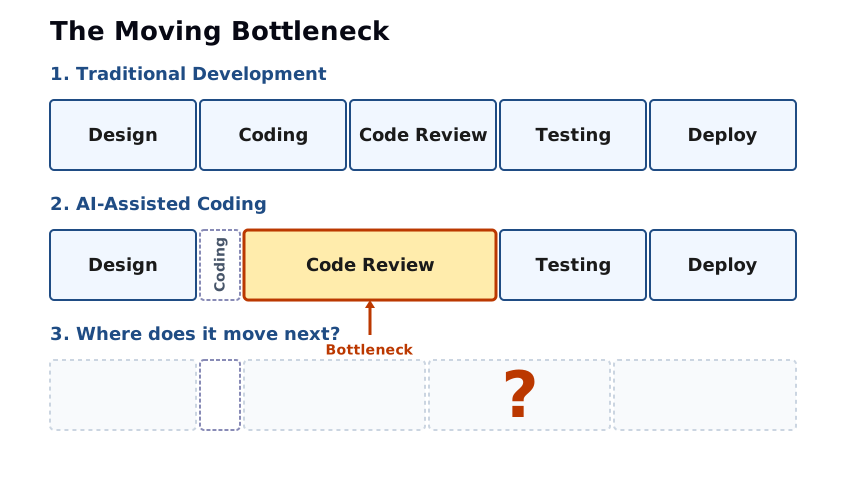
Why? Because coding is not the only possible bottleneck in software development.
In my Certified LeSS Practitioner training, we run a simulation called The Bottleneck Game. It demonstrates a fundamental principle of systems thinking and the Theory of Constraints: improving a step that isn’t the bottleneck doesn’t increase overall output. It just moves the pile of work somewhere else.
When AI shrinks the coding phase to 10% of its original time, the bottleneck immediately shifts. In fact, shrinking the coding phase actually prolongs the other phases because there is simply more volume to process.
Here is where the bottleneck moves and how to address it.
1. The Code Review Traffic Jam
When developers use AI to generate code, they produce larger pull requests, faster. If your team relies on asynchronous code reviews, the pile of unreviewed code will grow significantly. Waiting times explode, and merge conflicts become a nightmare.
Patterns to Fix It: You need to move away from individual pull requests and adopt Trunk-Based Development. You then apply selective reviews - you review only the most important changes or the critical components, it is not needed (and even possible) to read every line of code today.
2. The Testing Headache
More code means more features to test. If you rely on manual testing or separate QA phases, the backlog of “ready for test” items will quickly become a headache. Faster coding creates a pile of untested inventory. Even worse, the sheer volume of new code means that even your automated test suites will start taking too long to run.
Patterns to Fix It: You shift towards merciless automation. Agents can write tests as quickly as they can write code. You just need to make sure that they test the right things. You can experiment with Executable Specifications or any other technical excellence technique known before agentic coding. In general, it pays off to have as many deterministic checks as possible. You need to spend time on optimizing automated tests regularly so that they do not become your new bottleneck.
3. Deployment and Operations
Once the code is finally reviewed and tested, the bottleneck hits Operations. More features mean more deployments. People spend a massive amount of time in this phase today, and AI only makes it worse. Your operations work multiplies as you spend more time pushing code, monitoring, and trying to keep the system stable under the weight of constant changes.
Patterns to Fix It: Automate your deployment completely. If deployments require manual hand-offs, they will instantly become the new choke point. Use containerization and infrastructure-as-code to make environments predictable. Most importantly, invest in Product Observability so that when the system does break, you can detect and recover immediately instead of relying on manual firefighting.
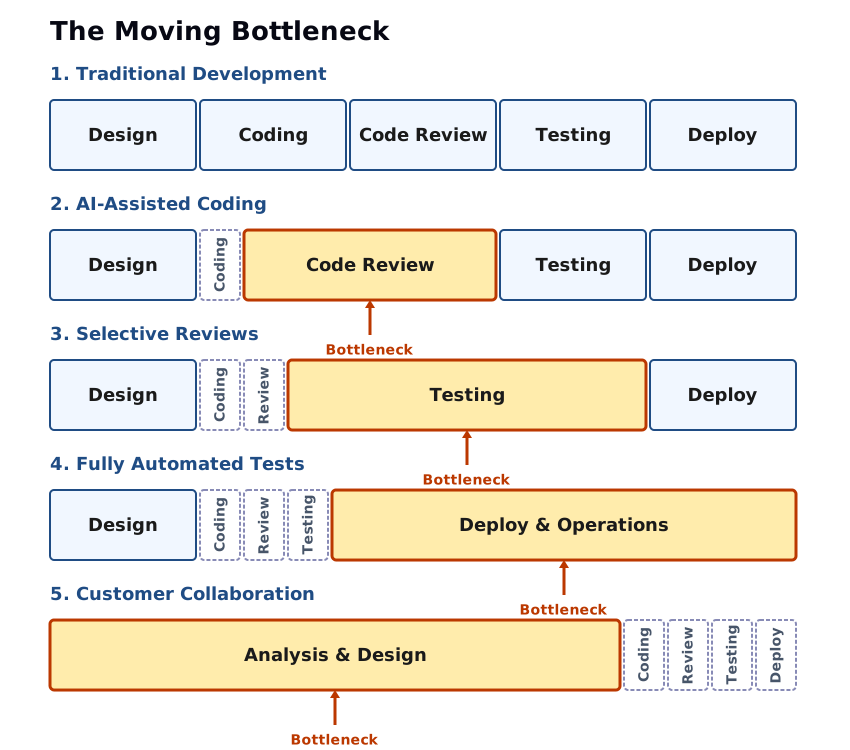
Notice a pattern here? The teams that start with AI coding usually move the botteneck to their downstream phases. Typically in this order - code review, testing, operations. Once reviews, tests, and deployments are automated and flowing, the bottleneck doesn’t disappear—it simply moves back to the beginning of the process.
4. The Design Bottleneck
AI agents need much more explicit context than human developers. A human can fill in the gaps; an AI will hallucinate if you don’t give it precise instructions. Because of this, you have to prepare longer, more detailed designs before coding even begins. The upstream work grows (at least at the beginning before you accumulate enough context in a written form).
Patterns to Fix It: Shift your focus to understanding the Whole Value Stream. You need tighter collaboration between product and engineering to ensure you are building the right things and specifying them clearly, not just throwing vague ideas at an AI. When engineering moves at AI speed, a standard two-week refinement loop starves the team of decisions. Instead, establish a Frequent business sync to align daily and unblock your developers instantly.
5. The Ultimate Bottleneck: Customer Collaboration
When your entire delivery pipeline is optimized from design through deployment, you hit the final boundary: the real world. Your capacity to build features might exceed your customers’ capacity to absorb them. If you are shipping 10x faster, but customers only give you feedback once a quarter, your speed is wasted.
Patterns to Fix It: You must shorten the feedback loop. Move to Shorter Iterations and ensure your Sprint Reviews are focused on actual end-user feedback, not just internal sign-offs. Delivering faster is only a competitive advantage if you are also learning faster.
Optimize the Whole
Local optimization is the enemy of product development. Speeding up a single phase like coding without addressing the surrounding collaboration patterns will only create more waste and longer queues.
To truly benefit from AI, you must optimize the whole product flow.
If you want to experience The Bottleneck Game firsthand and learn how to design team structures that handle these moving bottlenecks, join our next Certified LeSS Practitioner.